

When buyers are comparing their options, does AI recommend you?
See which recommendation prompts name you, which name a competitor instead, and how that changes week to week.
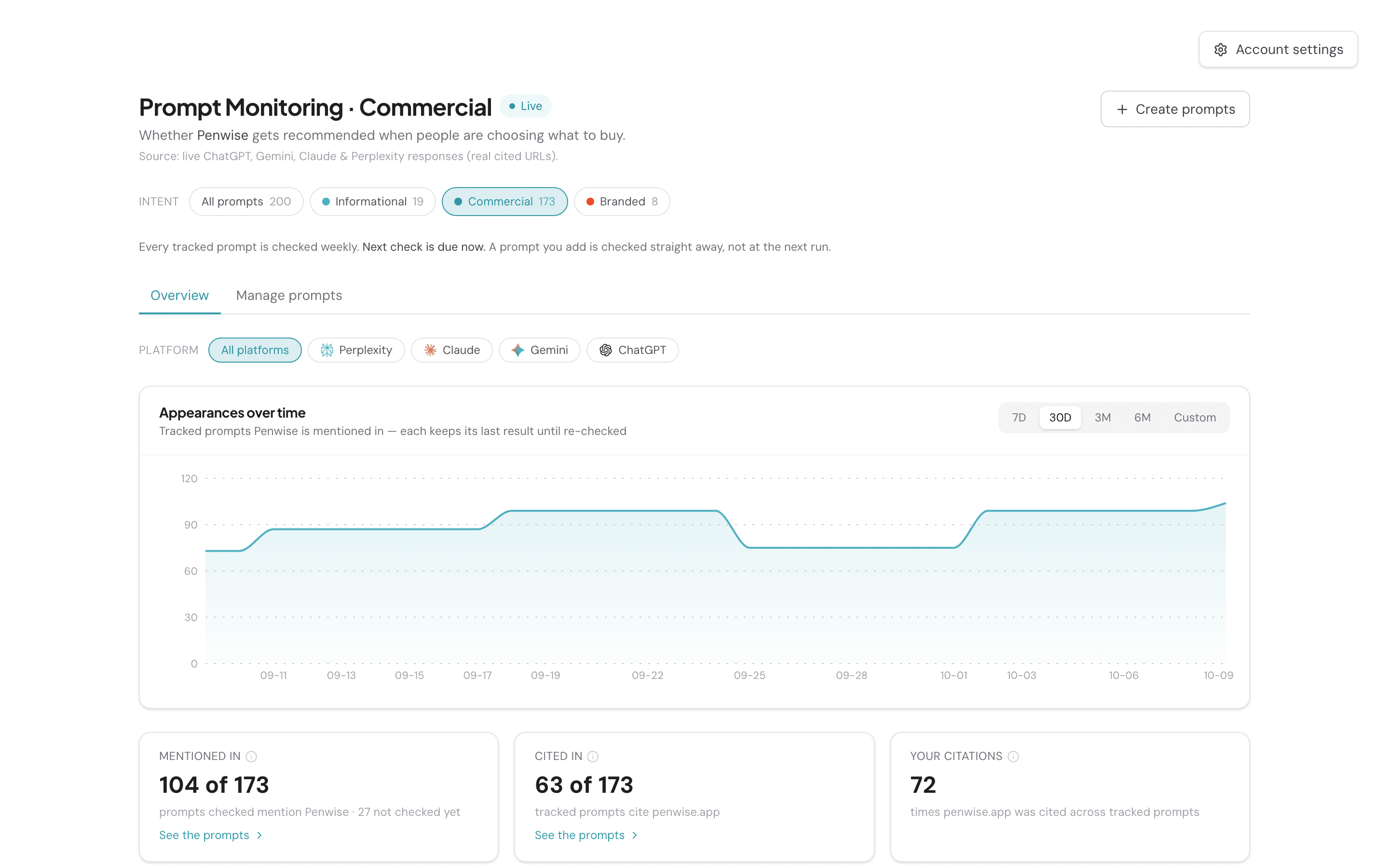
Prompt Monitoring on the commercial prompts · our demo account
Does AI recommend your brand to customers? Type a domain and we'll run the same check against it. No account, no card.
Being named is the whole outcome.
On a recommendation prompt there is no partial credit. Either the answer said your name or it said somebody else's, and every panel here counts that one thing — across platforms, against competitors, and over time.
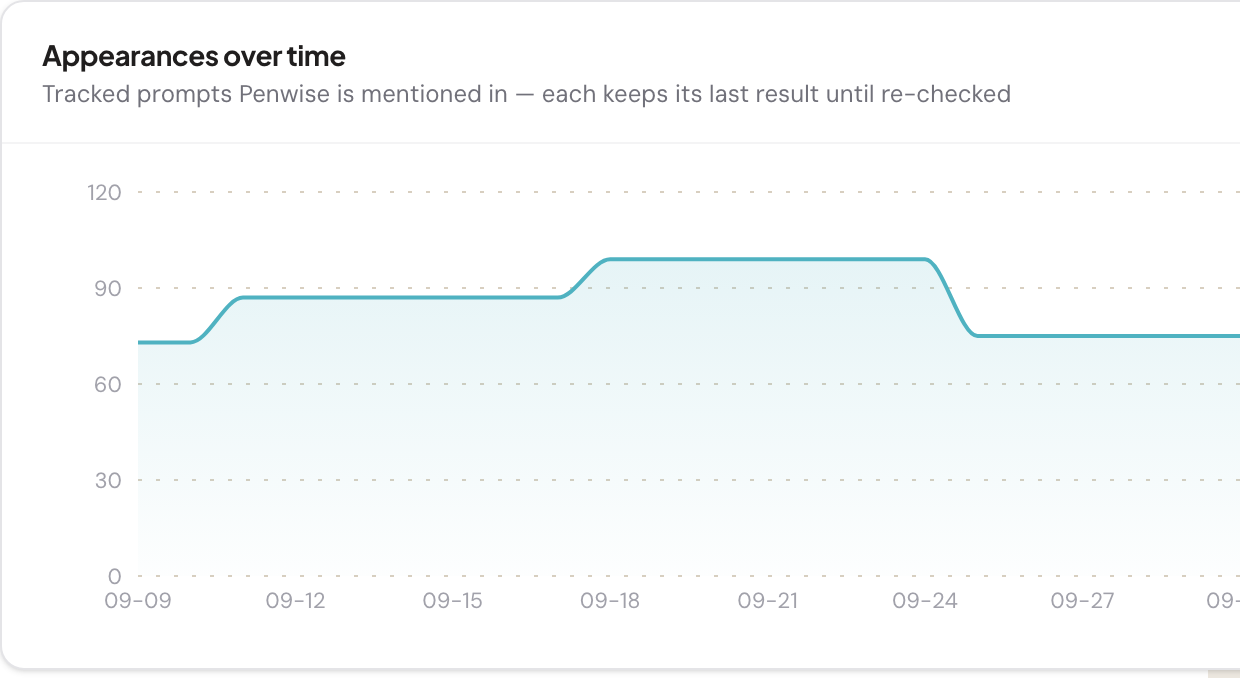
Appearances over time
How many of your commercial prompts return an answer that names you, checked on a schedule so you can see it move rather than guess.
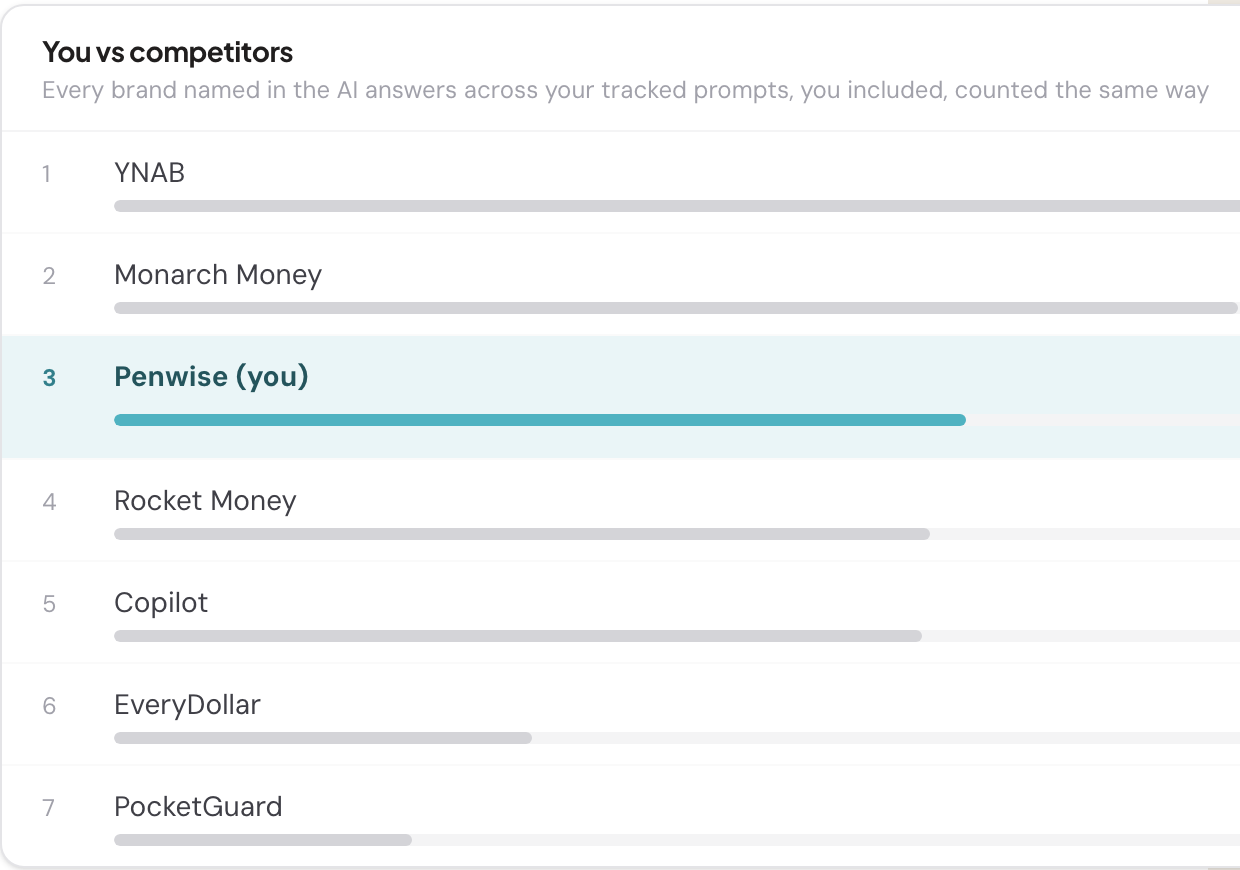
You vs competitors
Every brand the answers named, you included, counted exactly the same way. You sit wherever you actually sit.
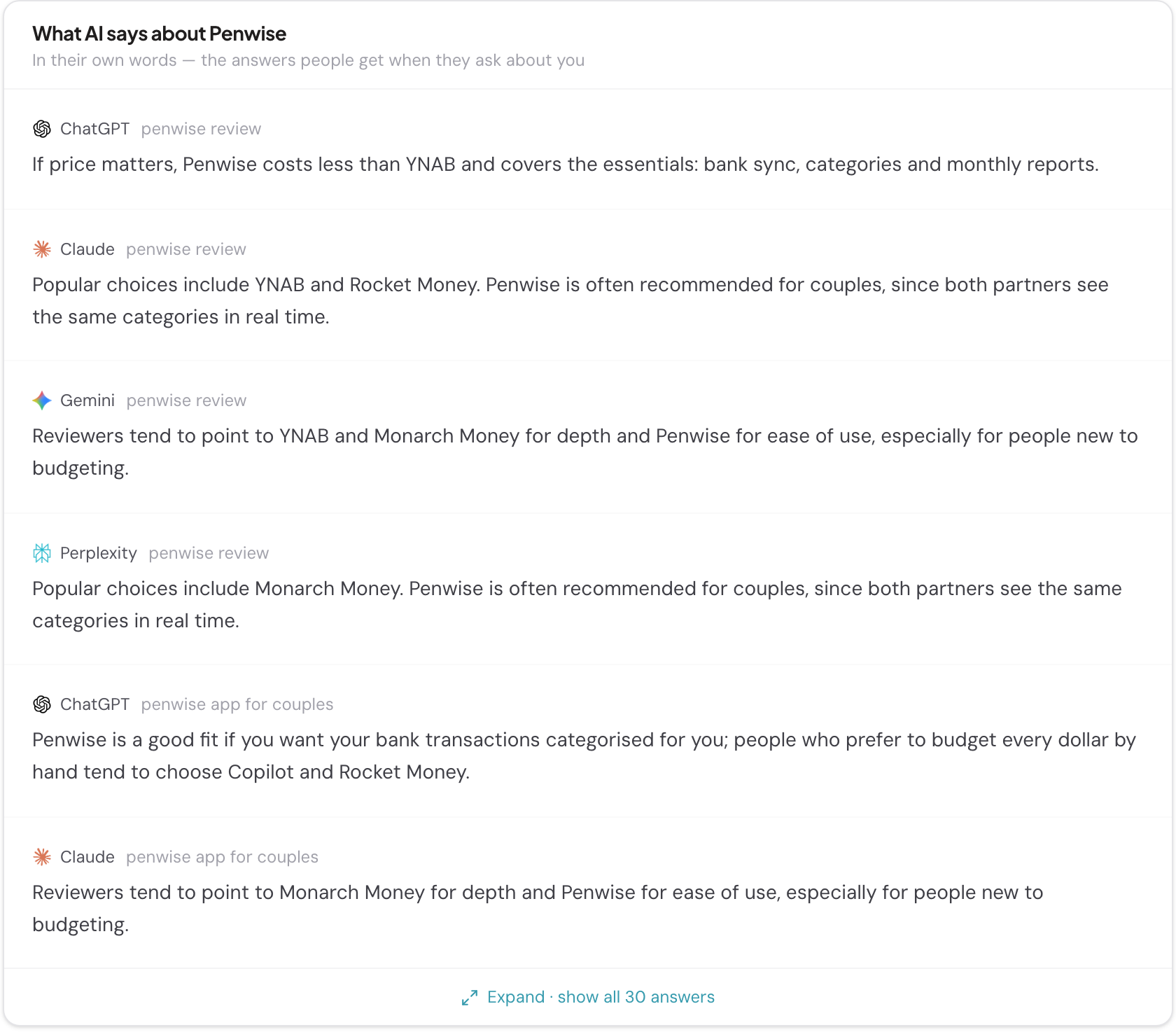
The answers themselves
What the LLMs actually said, word for word, so you can see how you were framed and who you were framed against.
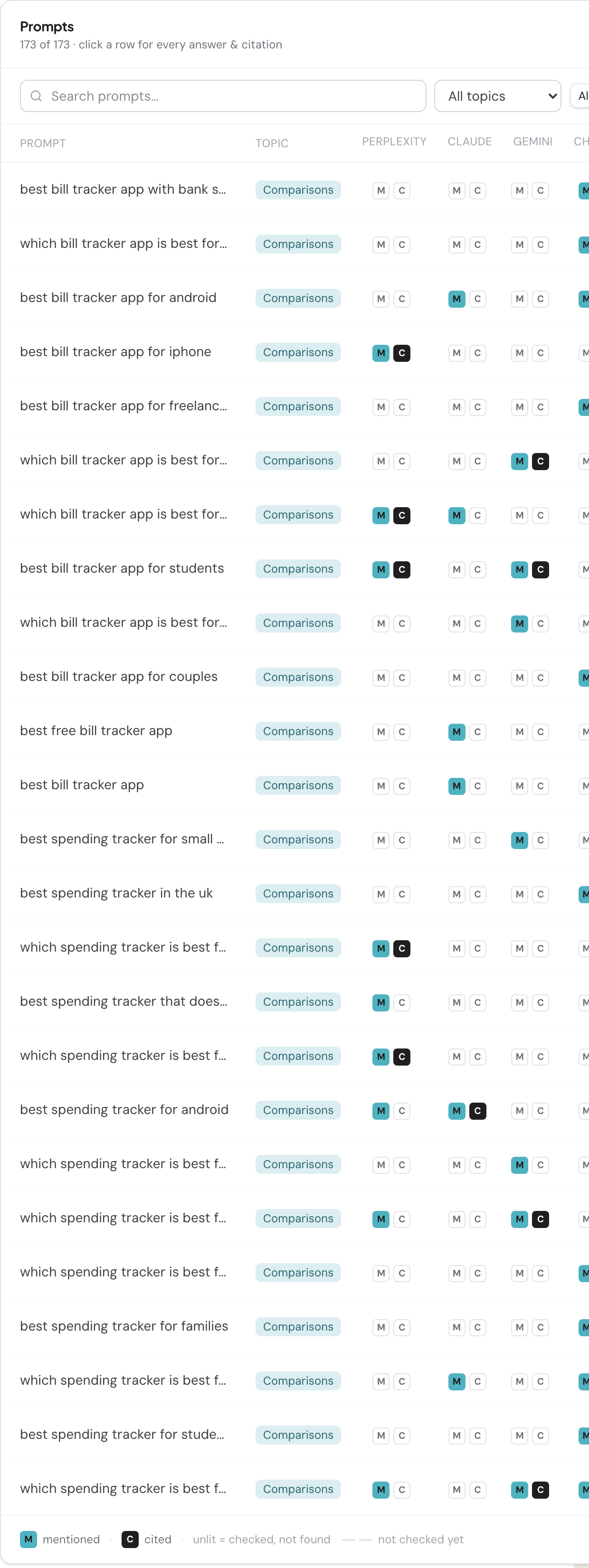
Prompt by prompt
Every buying question you track and which LLMs named you on it. Filter to the ones that didn't: that's the list that turns into work.
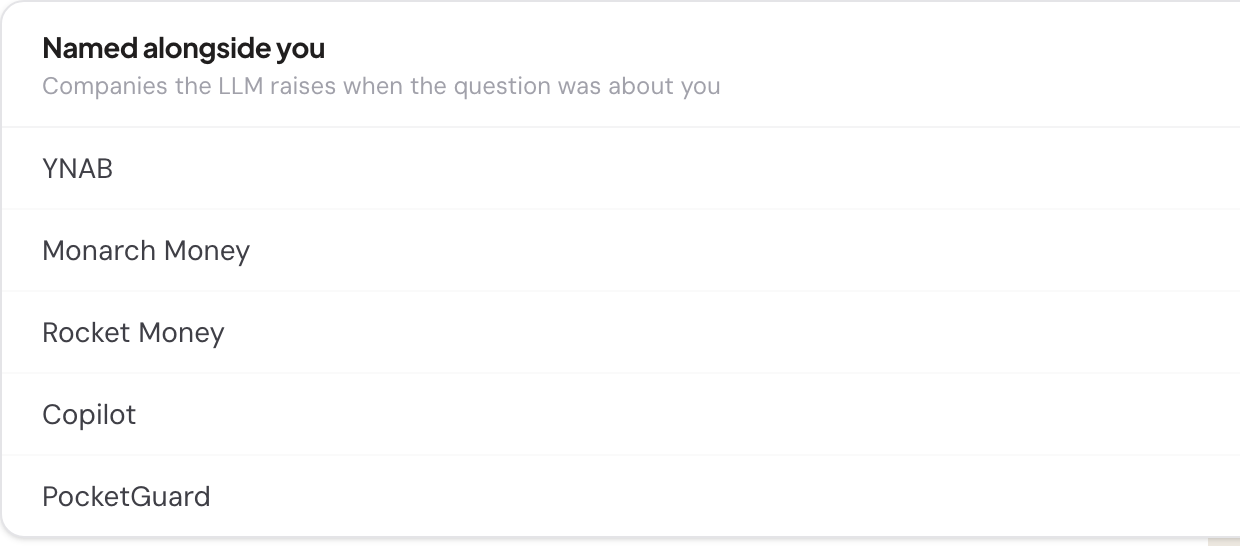
Named alongside you
Who keeps appearing in the same breath as you. Often not the competitors you track internally.
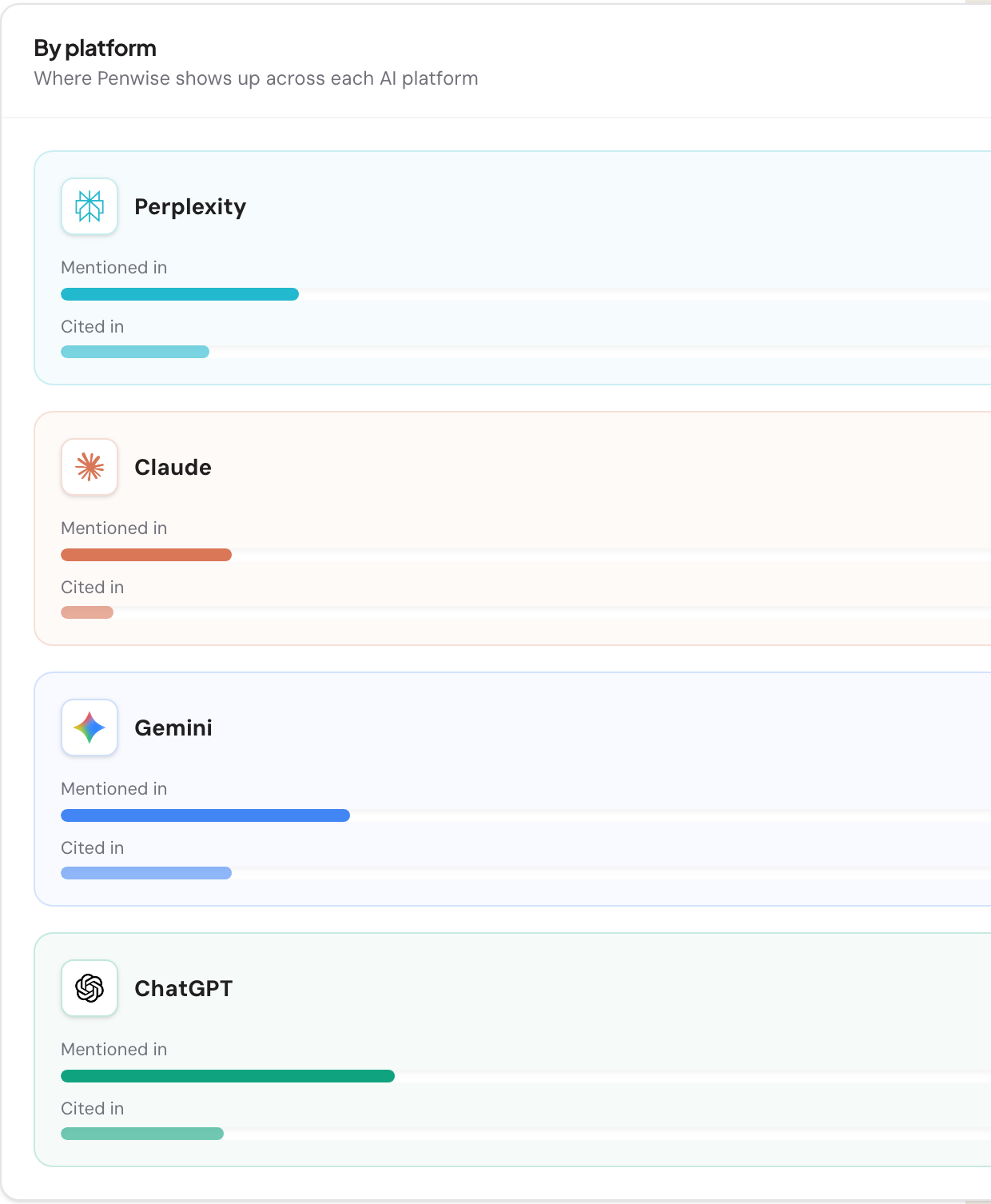
By platform
The LLMs disagree. Being the default recommendation on one and invisible on another is a different problem from being weak everywhere.
How it works, end to end.
Step one
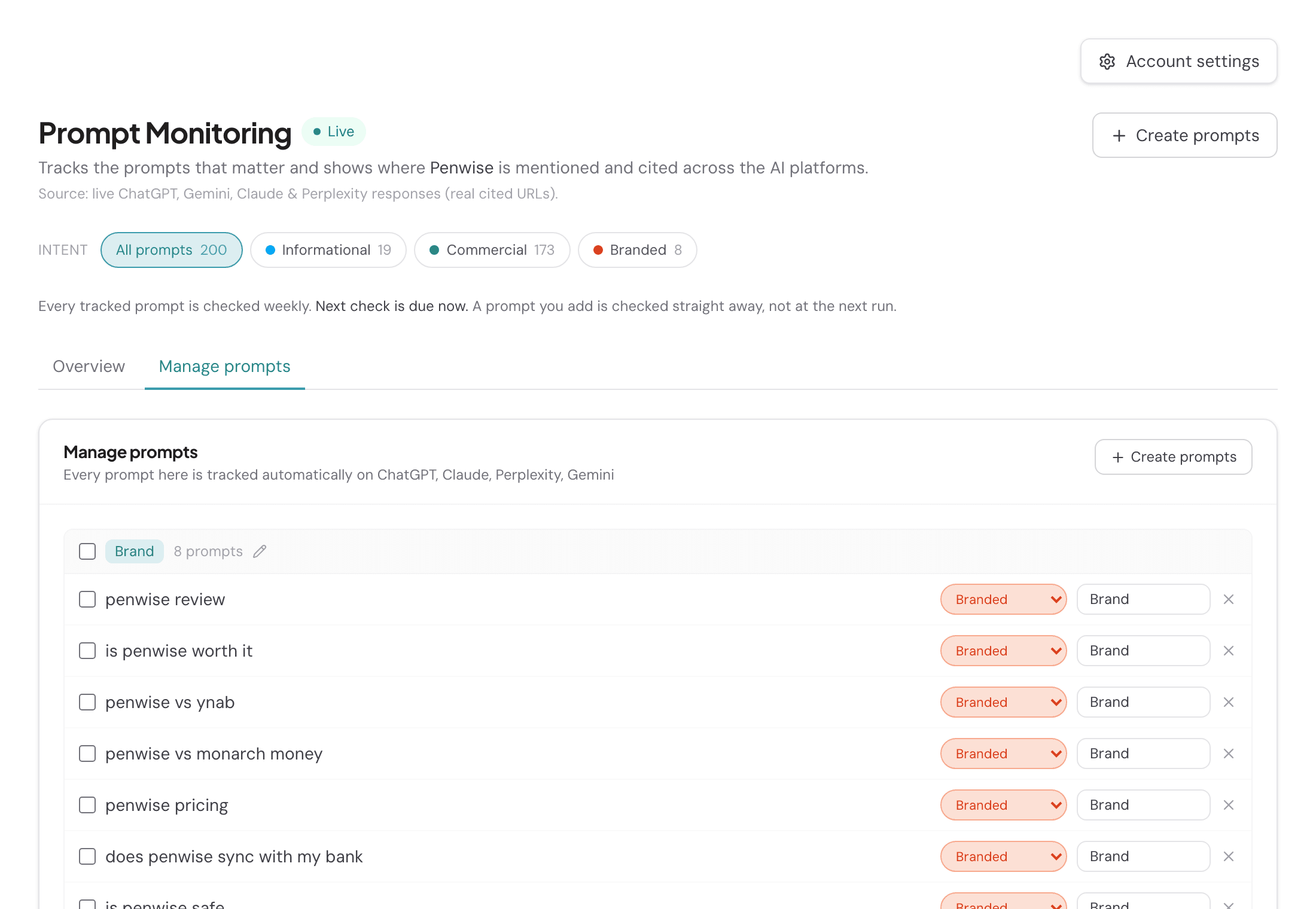
You choose the buying questions.
The sentences people actually type when they are close to a decision — “best X for Y”, “alternatives to Z”, “is A or B better”. Tag them commercial and they get their own view.
- Whole prompts, not keywords
- Tagged by intent, so buying questions are scored as buying questions
- Checked across ChatGPT, Claude, Gemini and Perplexity
Step two
We count who got named.
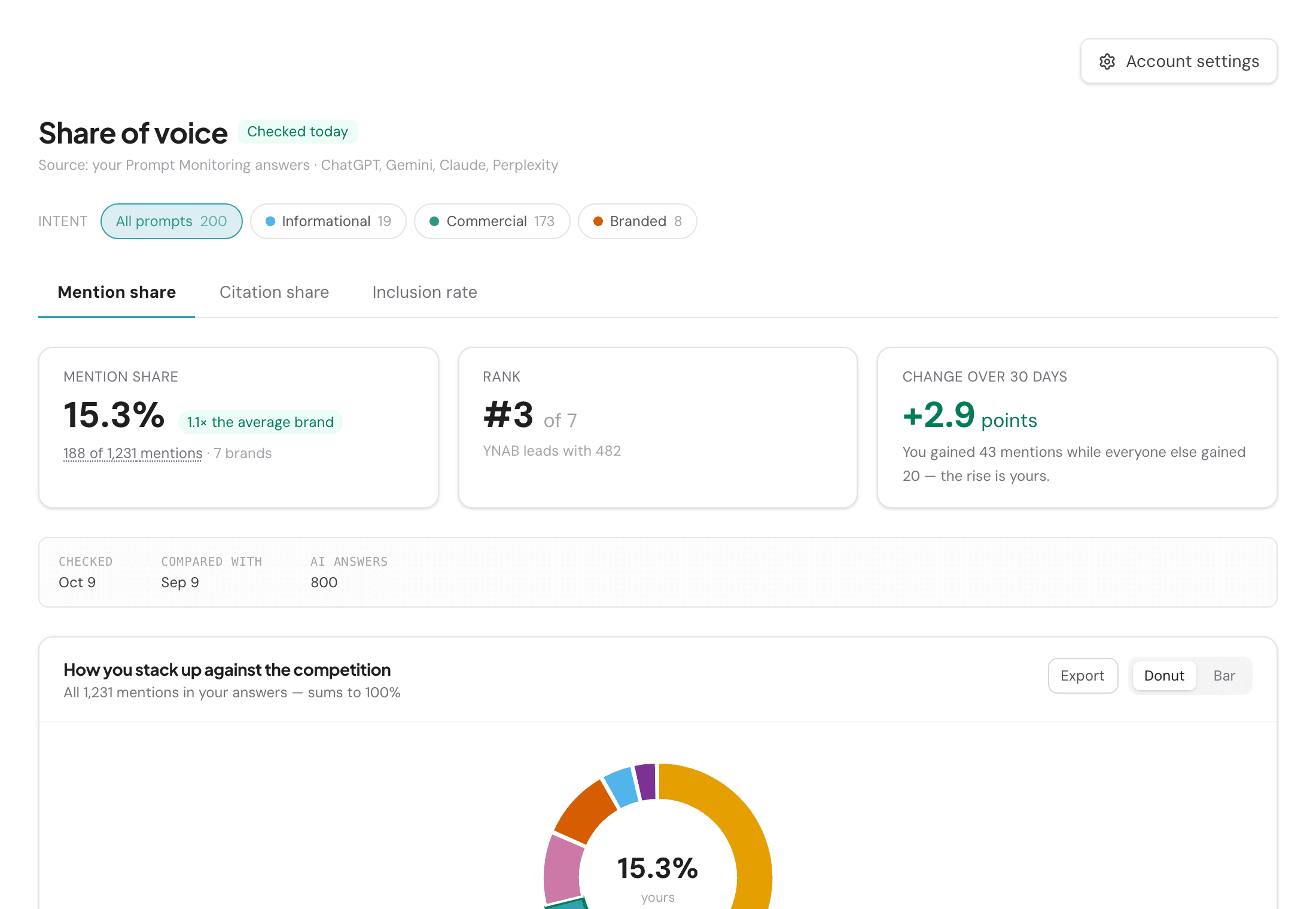
Every brand in every answer, counted the same way — including yours. No weighting that flatters the account holder, because a competitor table you cannot trust is worse than no competitor table.
- Named, cited, or absent — three facts, not a score
- Competitors discovered from the answers, not from a list you maintain
- Counts, never a share-of-voice percentage
Step three
You check it against real demand.
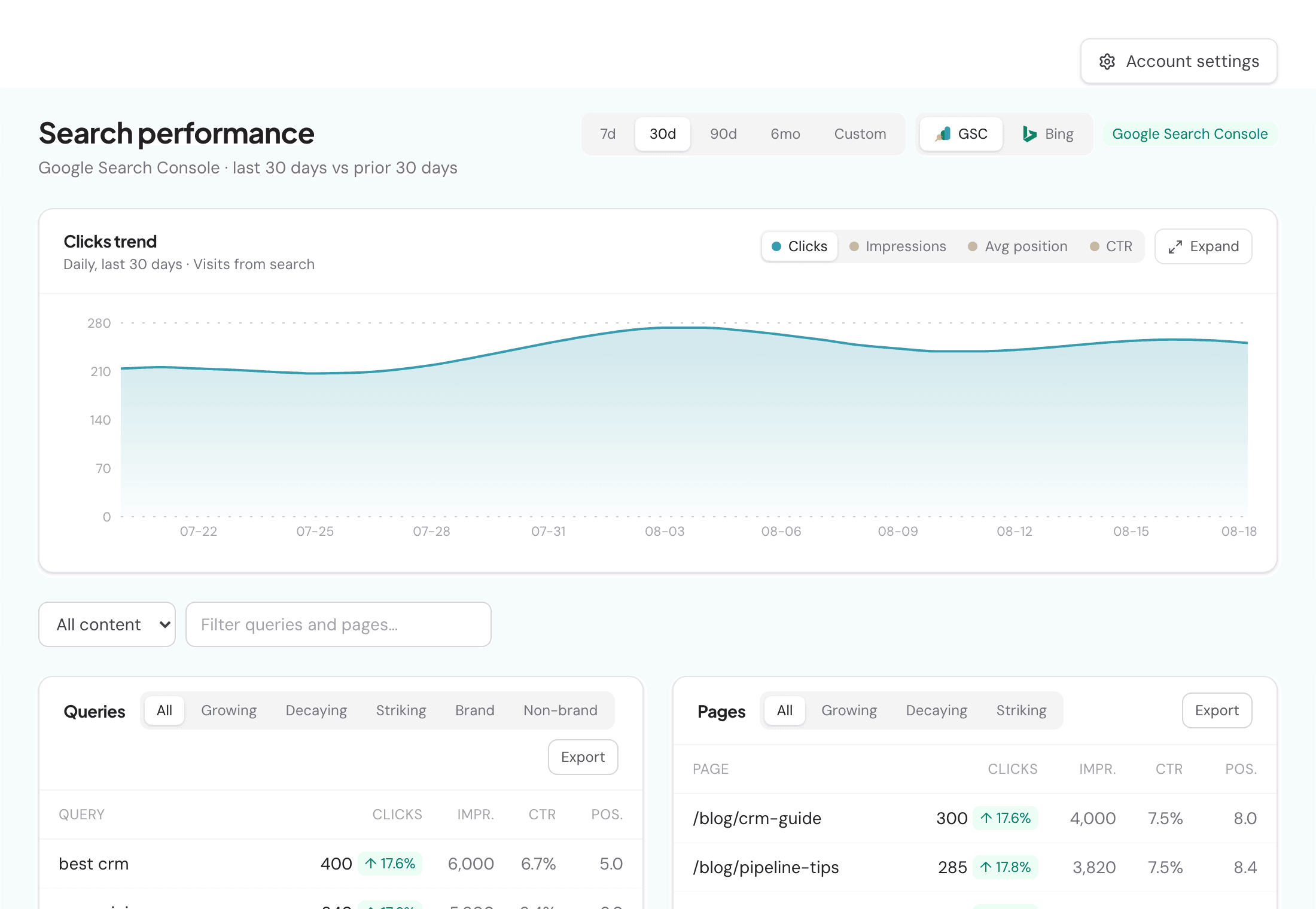
Recommendations sit next to Search Console and GA4, so you can tell whether getting named more often is turning into anything. Sometimes it is not, and you should be able to see that too.
- Search Console and Bing Webmaster, connected read-only
- GA4 sessions from AI platform referrals, split by AI platform
- One report rather than three tabs and a spreadsheet
Frequently asked questions
We don't — the answers do. Every brand named in an answer to one of your tracked prompts is counted, whether or not you consider them a competitor. That regularly surfaces companies teams weren't watching, which is usually the useful part.
Share of voice is a ratio built on a denominator we chose, and changing the prompt set changes the number without anything real changing. “Named in 38 of 72” can be checked by opening the prompts. A percentage cannot be checked by anyone, including us.
Not directly, and be careful with anyone who says otherwise. What you can do is see which prompts you're absent from, what the answers were built from, and who is being named instead — then go and be the thing those answers are built from. That's slower than a switch and it's the honest version.
No, and the distinction matters most here. An answer can cite your page as a source while recommending a competitor by name. We count them separately so a citation win isn't mistaken for a recommendation win.
Weekly by default. Recommendation answers move week to week rather than day to day, so a daily check mostly buys noise. You can run one by hand whenever you want to know.